Showing posts with label Arriflex. Show all posts

Tuesday, August 26, 2014

Arri hops on the 4K bandwagon with an upcoming firmware upgrade for the Amira


Following close on the heels of yesterday's news on the Sony F5 4K hack, Arriflex has issued a press release announcing an official "4K" UHD upgrade for the 2K Arri Amira (full text below). Of course, since this is Arri, the upgrade will not be free (how much it will cost is yet to be determined).

Interestingly, the release notes that the upgrade is in response to "user feedback". In other words, Amira shooters probably wondered why far less expensive cameras from Blackmagic and Panasonic recorded at higher resolution than their $40,000 cameras. It is also interesting to note that the Amira gets the upgrade and the Alexa does not.

Here's the full text of the release:

(August 26th 2014, Munich) – A new software upgrade for ARRI’s documentary-style AMIRA camera will allow it to record ProRes UHD files, answering the 4K requirements of some productions. The upgrade is expected to be available for purchase at the online ARRI License Shop by the end of 2014.
While widespread adoption of 4K or UHD for broadcast is still a long way off, an increasing number of content owners are becoming concerned that they ought to safeguard the longevity of their programs by ensuring that they will be suitable for UHD transmission, should that become a standard in the future. 
For those productions that do need to generate UHD deliverables, AMIRA will now offer the ability to record all ProRes codecs in Ultra High Definition 3840 x 2160 resolution directly onto the in-camera CFast 2.0 cards, at up to 60 fps. This feature, activated through an affordable software license (and a sensor calibration for existing AMIRAs), comes in response to feedback from AMIRA customers, some of whom have been quizzed about 4K deliverables by clients. It is made possible by the camera’s exceptional image quality, its processing power, and its reprogrammable system architecture.
Whether a production is pursuing a UHD workflow all the way through to distribution, or simply wishes to archive in UHD in order to future-proof itself against industry developments, AMIRA now offers an easy solution that requires no additional processes in postproduction.
IN-CAMERA PROCESSING
The ALEXA/AMIRA sensor has repeatedly proved its ability to deliver outstanding image quality for the 4K or even IMAX theatrical releases of high-end feature films such as Gravity, Maleficent and Iron Man 3. This proves that the ALEXA and AMIRA camera systems are already future-proof and more than suitable for the next generation of distribution formats.
For major feature films, an up-sample to 4K can be carried out after visual effects and other postproduction tasks have been completed at 2K resolution. For certain fast-paced AMIRA productions, however, there may not be the time or resources for such processes in post, which is why a 4K or UHD output direct from the camera has been requested.
AMIRA’s UHD output utilizes the same efficient 1.2x up-sample filter that allows ALEXA’s Open Gate mode to optimize the camera’s image performance for 4K distribution, as well as the same best-in-class sensor pixels. The up-sample to UHD happens in camera, and in real time.
SAME GREAT IMAGE QUALITY
Outputting UHD broadens the distribution options for the superior image quality that has helped make AMIRA, and ALEXA, such a success. The wide, 14+-stop dynamic range remains unaltered, as does the accurate colorimetry, natural skin tones, and organic look and feel. By making that high-quality image data coming out of the sensor compatible with higher spatial resolution formats, the UHD upgrade answers the concerns of certain regions and productions about a 4K future, allowing AMIRA to be used on any project, no matter what deliverables are required.
Markus Duerr, ARRI’s Product Manager for the AMIRA system, says, “Feedback about AMIRA from all over the world has been overwhelmingly positive and it is clear that the camera is already a great success, being used on an amazing variety of challenging productions. Already acclaimed for its phenomenal image quality, ease of use and versatility, the new ProRes UHD output will take these benefits even further, adding value for customers in areas like China, where 4K is a major focus of industry attention.”
Wildlife cinematographer Rolf Steinmann, who was nominated for an Emmy Award this year in recognition of his work with ALEXA on the BBC’s Wild Arabia series, is currently using his AMIRA on a movie for Disney Nature. He comments, "For cameramen like me who own their gear, the UHD upgrade is a great way to stay future-proof. From now on when there's pressure from the production side to deliver UHD, I can continue to work with AMIRA and won't have to compromise on image quality or on the camera's robustness and reliability." 
About ARRI:
With headquarters located in Munich, Germany, Arnold and Richter Cine Technik (A&R) was founded in 1917 and is the world's largest manufacturer and distributor of motion picture camera, digital intermediate (DI) and lighting equipment. The ARRI Group comprises a global network of subsidiaries and partners that covers every facet of the film industry, including worldwide camera, grip and lighting equipment rental through ARRI Rental; turnkey lighting solutions through the ARRI System Group; lab services, postproduction and visual effects through ARRI Film & TV; and film distribution through ARRI Worldsales. Manufactured products include the ALEXA camera system and AMIRA documentary-style camera; Master Anamorphic lenses; L-Series LED and M-Series HMI lights; Pro Camera Accessories; and ARRISCAN archive technologies. The Academy of Motion Picture Arts and Sciences has recognized ARRI’s engineers and their technical contributions with 18 Scientific and Engineering Awards.

In my view, this is just the beginning of the wave of 4K/UHD announcements and press releases we will see in the coming year. Manufacturers from Arri to Canon to Sony will introduce new 4K cameras and upgrade older models. If a camera doesn't record 4K, it will lose a lot of its market appeal. As a result, shooters will start unloading old 1080p and 2K cameras at bargain basement prices. It will be the story of the transition from SD to HD all over again.

This will be great news for entry-level amateur shooters who are looking to buy a 1080p camera in the next few months - but pros and high-end amateurs interested in delivering higher resolution to their clients and audiences may want to seriously consider upgrading - especially since there are reasonably priced cameras with 4K/UHD internal recording from Blackmagic and Panasonic already on the market.


Thursday, March 27, 2014

Panasonic GH4 - "C" Cam for Alexas?


Panasonic DMC-GH4 with DMW-YAGH Pro Audio Video Interface Unit - $3298


Another video from Thai cinematographer Sittipong Kongtong - scouting locations for his next picture with the Panasonic GH4 . Interestingly, the movie will be shot with two Arri Alexas, and, if he can get production firmware for the GH4, he'll use it as his "C" camera.
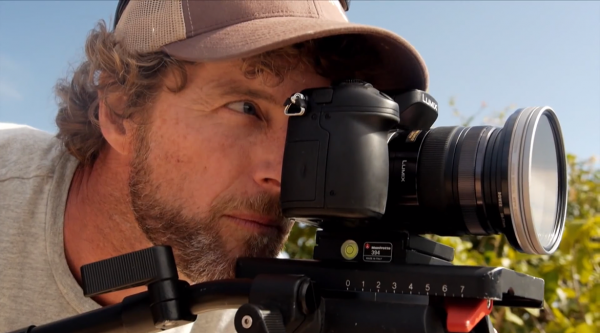


Once they get their hands on this camera, my guess is that a lot of professional cinematographers will use the GH4 to complement their REDs and Alexas.

As usual, if anything here has helped you to make a buying decision, please order through the links above or the display ads below. It won;t cost you anything extra, and it will help to keep these blog posts coming. Thanks so much for your support.

Sunday, March 23, 2014

Panasonic GH4 versus Arri Alexa Round 2 - 1080/96p Slow Motion!


Another side-by-side of the Panasonic GH4 and the Arri Alexa from Sittipong Kongtong in Bangkok. This time at 1080/96p conformed to 24p for 4X slow motion. Once again, the Arri is shooting a flat LOG 12-bit ProRes 4444, while the GH4 is shooting a normal color profile and h.264 8 bit 4:2:0.

But this time, the originating resolution and the delivery resolution is the same (even though compressed for YouTube). As in the previous GH4 96fps examples from Sittipong and from Jordan at The Camera Store, the GH4's 96fps looks to be very smooth and detailed. Freeze frames show no, or very little, motion blur (e.g., as is seen in Twixtor interpolation). Please watch at your monitor's highest resolution:


Again, at least for YouTube delivery, the $1700 GH4 stands up very well to the $44,000 Alexa.

For filmmakers on micro-budgets, this is very good news. For about the same price as a two day daily Alexa rental, filmmakers can buy a 4K GH4 with the YAGH audio video interface.

I am certainly grateful to Sittipong for posting these comparisons, but it would be nice to see a comparison between Panasonic's CineLook D color profile and Arri LOG. Perhaps next time.

As usual, if anything here has helped you to make a buying decision, please order through the links above or the display ads below. It won;t cost you anything extra, and it will help to keep these blog posts coming. Thanks so much for your support.

Thursday, March 20, 2014

Panasonic GH4 versus Arri Alexa - How Does 8-bit 4K compare to 12-bit 2K?


Sittipong Kongtong, a DP in Bangkok, Thailand has his hands on a preproduction Panasonic GH4 and has posted a few interesting clips. The latest is this side-by-side comparison (below) between the GH4 and the Arri Alexa.

Sittipong is a working DP and seems to be shooting these clips on the margins of his day job, so they're not as scientific as many of us would like. This test, for example, is not really a color space test - the Alexa is shooting a flat LOG 12-bit ProRes 4444 in 2K, while the GH4 is shooting a normal color profile and h.264 8 bit 4:2:0 in 4K (downscaled to 2K in post). This is more a resolution, 24 fps motion, moire and dynamic range comparison than anything else - and, in my view, the GH4 intercuts pretty well with the Arri in every one of those categories (at least on my small screen):


Panasonic GH4 4096x2160 vs Alexa 2048x1152 24P from Sittipong Kongtong on Vimeo.

I just booked my flight to Vegas for NAB - I am really pumped to see this camera in person. I have to make sure to order a Kingston UHS-I Speed Class 3 card before I go so I can record the usual shaky, dark trade show footage.

Seriously, I hope I can bring back something that is steady, in focus and decently lit so that people can make real judgments about what the camera can do. Hopefully, my familiarity with the GH3 will allow me to at least turn the camera on and record something useful.

As usual, if anything here has helped you to make a buying decision, please order through one of the links or display ads on this page. It wont cost you anything extra, and it will help to keep these posts coming. Thanks again for your support!


Friday, January 31, 2014

In LA? Arri Amira Available for Preview!


According to The Hollywood Reporter, Arri is previewing a prototype Amira at their offices in Burbank this week.  I'd call ahead to check on the camera's availability first, though (818-841-7070).

If you do stop by, please post a comment to the blog to tell us what you thought!

P.S. - sadly, it looks like the camera will be $40K rather than $30K when it is introduced in April - which will push it closer to $2000 a week for rental.  But, as I said in the earlier post, it will save you at least that much in time and money in post-production.


Thursday, January 30, 2014

Arri Amira - Canon C500 Killer?


VS


When I was in film school in the 1970s, I read magazines such as American Cinematographer, AFI's American Film and Filmmaker.  I spent hours poring over articles with pictures of Arri 16 and 35mm cameras on set with my heroes - Stanley Kubrick, John Cassavetes, Martin Scorsese and others.
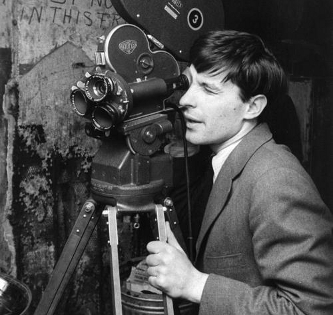
John Cassavetes with Arri 16ST

I remember looking at pictures of the fabulous Arri 16 and 35BL shoulder mounted cameras and thinking - "These are the perfect cameras for independent filmmakers.  Pick one up, load it with film and just go out and shoot.  Maybe, someday, I'll rent one of these, put it up on my shoulder, go out on the street and shoot my movie..."


Kubrick on the set of A Clockwork Orange with Arri IIc

But, then reality would set in.  Even after buying expensive film stock, shooting guerrilla on the street and convincing your friends to act in your movie for free, there were still huge processing and duplication costs and let's not get into editing and coloring.


Martin Scorsese with Arri 35BL

Fast forward 40 years.  A few days ago, Arri turned all that on its head when they announced the European prices for the new, shoulder-mounter, 2K 200fps Arri Amira ProRes camera  - prices aimed squarely at cameras such as the Canon Cinema EOS C500.


AMIRA Showreel from ARRI Channel on Vimeo.

At €25,980, the Amira is likely to come in right around $30,000 when its price is announced in the States. This was the list price for the C500 - until its recent markdown to $19,999 (perhaps Canon knows something?)

Independent filmmakers and DSLR shooters stepping up to the next level have so far gravitated toward the Cinema EOS cameras because they overcame many of the challenges presented by DSLRs - but these "cinema" cameras still require a shoulder rig and an external viewfinder for handheld shooting.

And, if you want the Amira's ability to shoot ProRes straight to the camera, you have to put up with Blackmagic Production Camera's lack of XLR inputs, ND filters and overall poor design (offset somewhat, but not completely, by its amazingly low price).

Or, if you want high speed frame rates comparable to the Amira's 200fps slow motion, you have to buy a Sony FS700 - with its ridiculous top mounted LCD/viewfinder.

Straight out of the box, none of these are handheld, self-contained cinema cameras, by any stretch of the imagination.

As Andrew Reid over at eoshd says in his thoughtful piece on the Amira, "[Canon Cinema EOS]...ergonomics have garnered praise only because the competition has been even worse."

That said, the shoulder mount is very cool, but what has me really excited about this camera is the 2K, 14-stop dynamic range, ProRes output to a CF card.  Straight from a 14-stop DR camera to an inexpensive card reader and into any NLE.  Heck, even my little laptop can handle that.

I have had a tiny taste of what that means for easy, high quality workflow with my little Blackmagic Pocket Cinema Camera.  One of the best things about this $995 marvel is its ProRes 422 output to a relatively inexpensive, fast SDXC card.  Many people started out clamoring for RAW with this camera, and ended up, as I have, shooting primarily to ProRes.  It's just that easy.

For me, this workflow advantage is just as important as the camera's ergonomic superiority and wide dynamic range.  Shooters won't need to go to post-production houses to edit and color their high quality images - they won't even need to buy expensive SSDs or computers capable of processing RAW.

Forty years ago, post-production costs were the barrier that kept many people from making the movies they wanted to make.  This camera breaks that barrier down, in a big way, and may save enough time and money in post to be worth the ~$1500 a week it will cost to rent it (based on the C500 rental price at Borrowlenses).

For me, this is more important than either 4K or internally recorder lossless RAW, and makes this camera revolutionary.

Without buying a shoulder rig, follow focus, SSDs, an external EVF or loupe, an external recorder, screw-on NDs, or the time and expense of complex post-production workflow, filmmakers can, as the Arri tagline says, just "pick up and shoot".


So this morning, for the first time in a few decades, I found myself looking at pictures of a new Arri shoulder mounted camera, and thinking - "maybe..."

Monday, October 1, 2012

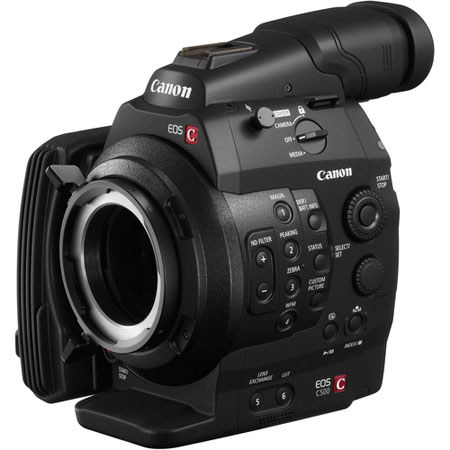
Canon Goes *Way* Upmarket with 4K C500


It looks like Canon is serious about competing with Arri, RED and Sony for the high end cinematography market.  Rolled out today at a big shindig in Hollywood (hat tip to Creative COW), and priced at $26,000, the new 4K C500, big brother to the $16,000 C300 and $6,500 C100, appears to undercut high resolution RAW cameras such as the Arri Alexa, the RED Epic and the Sony F65 - all of which cost over $50,000.

If you're a Canon shooter with a big budget feature to shoot this Christmas, you can pre-order your EF mount or PL mount C500 at Adorama today for November delivery. Your card won't be charged until it ships!