Showing posts with label Best Mirrorless. Show all posts

Saturday, February 7, 2015

Olympus OM-D E-M5 Mark II - lone standout in another boring bunch of camera announcements

Olympus OM-D E-M5 Mark II


With the recent spate of new camera announcements, one might have expected something new from the major manufacturers on the video front.

Not so fast.

Yes, Canon now offers a new super high resolution full frame still camera to compete with the Sony A7r - but it offers nothing new for video.

There's a new version of the mirrorless Canon EOS M - but they won't be selling it in the States.

Samsung has announced the NX500, a new 4K mirrorless NX-1 "mini me" for a great price - but they've stripped the NX1 not only of its viewfinder and headphone jack  - but also its microphone input. Fail.

And the new Canon T6i has now caught up with 2013-era still/video cameras, adding wi-fi and fast video autofocus (but still no 1080/60p - and, of course, no headphone jack).

In my view, the only recent announcement that might be exciting for filmmakers is the new $1099.99 list Olympus OM-D E-M5 Mark II. With its 5-axis stabilization, new fully articulated LCD, 1080/24p/60p, 50mbps bit rate and headphone jack, Olympus finally appears to be taking video seriously.

The handheld walking clip at 9:10 in The Camera Store's review of the E-M5 Mark II is very impressive:


Except for the 30 minute continuous clip length limit, the OM-D E-M5 Mark II is now very competitive with the Panasonic GH3 for videography and filmmaking. Links for pre-ordering the silver (or black) Mark II are up now at Amazon and Adorama.

Unfortunately for Olympus, the GH3 is a two year old camera and the street price is now below $800. In my view, Oly is going to have to step up its game just a little more to catch Panasonic in the hybrid still/video race.

My suggestion - a 4K version of this camera (with 5-axis stabilization) that lifts the 30 minute continuous recording limit.  Such a camera would certainly give Panasonic's GH4 a run for its money. OM-D EM1 Mark II, anyone?

All of that said, despite the good news from Olympus, the other major manufacturers don't seem interested in fixing the problems that still bedevil video-capable large sensor interchangeable lens cameras in 2015, e.g. weak codecs (no in-camera RAW), rolling shutter, no XLR inputs, the lack of built in stabilization, no affordable power zooms and no built-in NDs.

The Blackmagic URSA comes close, but it has no stabilization, no NDs and it's a 20 lb. camera.  The JVC GY-LS300 looks like it produces high quality, gradeable 4K video - but it lacks internally recorded RAW and a global shutter (as does the Sony PXW-FS7).

What we need is a "usable" (10 lbs or less) Blackmagic Camera with a viewfinder, stabilization and compatibility with Panasonic power zooms - or an affordable Canon Cinema EOS camera with RAW, a global shutter and a power zoom - or something like the FS7 from Sony with RAW and a global shutter.

Perhaps we'll see some progress at NAB.  I hope I can convince the Board Chair here at HCR to let me go this year :)

As always, if anything here has helped you to make a purchase decision, please shop using the links above or the displays below and in the margins. And even if you're not in the market for a new camera, please comment and make suggestions below. It won't cost you anything extra, and it will help to keep these posts coming.

And for the latest deals, news, tips and techniques, please follow HCR on Blogger, Twitter and YouTube  - and circle us on Google+.


Saturday, October 25, 2014

Submit a clip to Samsung's "In a City" contest by October 30th for a chance to win a free NX-1!


Samsung and actor/producer/director Joseph Gordon-Levitt (Third Rock from the Sun, Looper, Don Jon) have teamed up to create a great contest for aspiring writers and cinematographers who want to work with JGL to crowdsource a short film, shot with the new Samsung NX1 (detailed rules in the video below).

As part of the contest, you'll have a chance to win a new NX1 - arguably the best value for money interchangeable lens 4K camera on the market. And if you don't win, you can always buy your own NX1 by clicking on one of the display ads below :) Good luck!


Sunday, July 20, 2014

Panasonic GH4 "Range Wars" - Which Dynamic Range Test Do You Believe?


The $1699 Panasonic GH4 seems to elicit some pretty strong reactions. Opinions run the gamut from reviews like "Best Camera Ever?" to a "scientific" test called "Dynamic Range – Sony A7S vs. the others" where the results seem to confirm the testers' preconceptions, e.g,  "the rather videoish look and contrasty colors we can subjectively observe" from the GH4.

Here's the chart showing the results of this test (using the $3540 Xyla21 – 21 step Grayscale Combi-DX1):


GH4 CineLike Dynamic Range Test - Assessed as 10.9 stops by Cinema5D

The post describing these results gives us a few details about the methodology (e.g., the lens and ISO they used), but doesn't show waveforms or tell us which CineLike profile the testers used (this is important because CineLike V has less DR than CineLike D).

Fortunately, we can compare these results to other data-driven tests. The best I've seen is "Panasonic GH4: DR and Gamma, Timelapse, and More" from Adam Wilt writing for dvinfo.net.

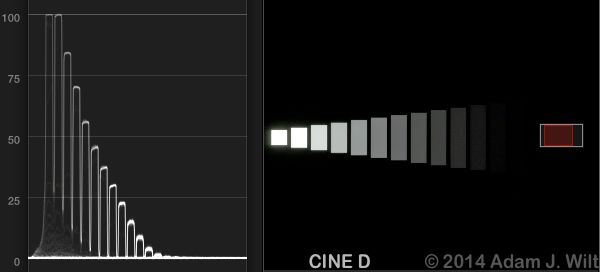
Adam also used the Xyla 21 to test the GH4's Dynamic Range - but he tested it across various color and CineLike profiles. Here is his result for CineLike D:

GH4 Dynamic Range Test - Assessed as 11+ stops by Adam Wilt at dvinfo
Why the clear difference between the results of the two tests? Perhaps the Cinema5D testers used CineLike V instead of CineLike D. Or perhaps it was confirmation bias related to the subjective observations about the camera's "videoish" look.  Hard to know.

Personally, I don't see a "videoish" look from my GH4 unless I want it.  Neither do I see it from Phil Bloom's 4K Postcard from Phang Nha or Guillaume Le Berre's Kaydara.

That said, I really respect the effort the folks at Cinema5D put into this test, but in light of the significant difference with the dvinfo results, they might want to take another look at their conclusions.


Thursday, June 12, 2014

New 4K Panasonic FZ1000 - Sony RX10 Killer?


Last night, Panasonic announced the first UHD ("4K") camera below $1000 - the $897.99 Panasonic DMC-FZ1000 (available for pre-order at Amazon and Adorama). This camera has a list of great video features in addition to UHD - such as a 1" sensor, focus peaking and zebras, 5-axis stabilization and cine gammas. Here's a nicely shot UHD video from Panasonic (please watch at your monitor's highest resolution):


Aimed squarely at Sony's $1298 DSC-RX10, this camera has a very similar 1" 20MP sensor - but it tries to 'improve' on the RX10's terrific 8.3X constant aperture f2.8 lens by doubling the zoom range.  It's not much of an improvement, however, because the longer zoom range is offset by the loss of constant aperture (the new lens' aperture is a not very impressive f2.8-4.0).

It also fails to match the RX10 in other ways that matter to video shooters - it has no metal weather-sealed body, no ND filter, and no headphone jack.

In addition, when recording UHD, the US model is limited to 30fps and 30 minutes of recording time (25fps for the PAL model).  No 24fps.

Given the lack of serious video features, the addition of focus peaking, 5-axis stabilization, cine gammas, UHD "4K" and the 1" sensor may not be sufficient to compensate for this camera's shortcomings.

Bottom line - Reports of the RX10's demise are greatly exaggerated. At $897.99, the FZ1000 may sell well, but I don't recommend it for serious video shooters. If you want a compact superzoom with serious video chops, I recommend saving up an extra $400 for the RX10 - it's a great 1080p video camera with a headphone jack and a metal body that can stand up to a little weather.

If you want the flexibility and creativity of interchangeable lenses, you can get an all-metal GH3 body with a headphone jack for about $100 more than the FZ.

And for shooters who really want to upgrade to 4K - I recommend saving up for a camera that records to real 4K and 24fps - and without a 30 minute limit - the GH4.


Sunday, June 8, 2014

Record 10-bit 4:2:2 ProRes with a $295 Atomos Ninja Star Recorder and $160 Atomos CFast 1.0 Card!


When Atomos announced their new 1080p ProRes recorder, the $295 Ninja Star, at NAB 2014, it was seriously overshadowed by all the hype surrounding their new 4K HDMI recorder, the $1995 Shogun. But, over the last few months, excitement has built over the Star - principally because of its price point.

But the catch has been Atomos' choice of the Star's recording medium - CFast cards, the 2.0 versions of which have been priced in the thousands of dollars. But Atomos has just fixed that with the announcement of an Atomos-branded CFast 1.0 card.

Here's the announcement from Jeromy Young (CEO and founder of Atomos) to Nate Weber over at newsshooter.com - shot last week at CineGear 2014 in LA (I wanted to drive down, but the CEO here is cutting back on my expenses :)):


This is really exciting news. Until now, the least expensive "field" recorder has been the bulkier $327 Blackmagic Hyperdeck Shuttle. I put "field" recorder in quotes because powering the Hyerdeck requires an AC outlet or generator.

The Ninja Star, on the other hand, will be just $295 and battery powered - with HDMI pass-through; an audio level monitoring display, a time remaining indicator and large, readable controls.  With a $159 64GB CFast 1.0 card, you'll be able to record 10-bit 4:2:2 Pro Res to a CF card for a total of $455!  For those who don't need the monitor built into the $695 Atomos Ninja 2, that's a big deal.

The other exciting news in the video is Atomos' custom micro HDMI to micro HDMI cable. With this cable, Panasonic GH4 shooters will be able to record 1080p 10-bit 4:2:2 ProRes straight to a tiny external recorder without the additional hassle and weight of a micro HDMI to HDMI adapter.  This will be ideal for aerial or run and gun shooters, who need a compact and lightweight solution.

If anything here has helped you to make a buying decision, please click on the links above or the display ads below.  It won't cost you anything extra, and it will help to keep these posts coming.

And please follow us on Blogger, YouTube and Google Plus. Thanks for your support!


Friday, June 6, 2014

BBC Shoots Amazing Aerial Footage of Brazil with the Venerable GH2!


I lived in the UK for 5 years, and was always impressed by the BBC's willingness to explore new technologies for news gathering.  Here is some great BBC multicopter footage of Rio and back country Brazil shot with a classic Panasonic GH2:


And here is an interview with the pilot:


If you want one if these great ¨old"cameras, you can still pick up a used body starting at about $540 in the US and about £400 in the UK.

Friday, May 2, 2014

Straight Flush - Panasonic GH1/GH2/GH3/GH4 Family Picture


I took this picture almost as soon as I had the GH4 out of its box.  It's hard to remember how revolutionary the GH1 seemed back in 2009.  Video autofocus, an Electronic Viewfinder, camcorder-like recording times, 1080/24fps and a swivel screen made it arguably the most advanced video-capable, large sensor, interchangeable lens camera of its time.

But time marches on, and the new Panasonic GH4 quadruples the video resolution of the earlier cameras - and is a much better still camera too.

I'll be taking the GH3, GH4 and the BMPCC up to the Travis AFB air show in Fairfield, CA for a comparison shoot tomorrow. The GH4's battery is charging, and I'll take a few UHS-1 SD cards to experiment with.

I'll be leaving the old GH1 and GH2 behind, though. I don't see a lot of demand for GH4 comparisons with 2009/2010 era cameras.

Results coming soon!

Thursday, April 24, 2014

Selling my Pocket Cinema Camera for a GH4 - Why?


I still love my Blackmagic Pocket Cinema Camera. I have found ways to overcome its handling limitations (with an inexpensive LCD shade, a loupe and a pistol grip).


I have learned to combine its expanded image and peaking features for razor sharp manual focus, its small form factor is convenient and visually appealing, I absolutely love 10-bit ProRes and, now that the GH3 is back over $1000, the BMPCC is the only sub-$1000 camera with a headphone jack. So, why am I selling it to buy a Panasonic GH4?

Because the BMPCC is the last camera I pick up when I leave the house. On the other hand, I take the GH3, with its 'inferior' 8-bit codecs, everywhere I go. It turns out that I need to be able to shoot a high quality still photo every once in a while - and an iPhone just doesn't cut it for me. So, I guess I chose the right title for this blog. I am a hybrid still/video camera shooter, still looking for the "revolutionary" camera that can do it all. Is the GH4 that camera? Hopefully, we'll see in a few weeks.

If you're looking for a 12-bit RAW cinema camera for $899 and you're in in the SF Bay Area, click on one of the pictures above or this link to see my Craigslist post. If you prefer a new BMPCC, GH3 or GH4, please click on one of the links above or the display ads below. It won't cost you anything extra, and it will help keep these posts coming. Thanks!

Thursday, March 27, 2014

Panasonic GH4 - "C" Cam for Alexas?


Panasonic DMC-GH4 with DMW-YAGH Pro Audio Video Interface Unit - $3298


Another video from Thai cinematographer Sittipong Kongtong - scouting locations for his next picture with the Panasonic GH4 . Interestingly, the movie will be shot with two Arri Alexas, and, if he can get production firmware for the GH4, he'll use it as his "C" camera.


Once they get their hands on this camera, my guess is that a lot of professional cinematographers will use the GH4 to complement their REDs and Alexas.

As usual, if anything here has helped you to make a buying decision, please order through the links above or the display ads below. It won;t cost you anything extra, and it will help to keep these blog posts coming. Thanks so much for your support.

Monday, March 24, 2014

Panasonic GH4 Low Light Footage


Panasonic DMC-GH4 with DMW-YAGH Pro Audio Video Interface Unit - $3298


Another clip from the preproduction Panasonic GH4 from Sittipong - this time beautiful 800ASA low light footage on the streets of Bangkok. Please watch at the highest resolution possible on your monitor:


There are a couple of rough spots with focus and exposure, but this was unplanned shooting and I don't know what his settings were, so I'm not that worried about that. In my view, the dynamic range and resolution look pretty good in this example, although I continue to take everything I see on YouTube with a grain of salt.

As usual, if anything here has helped you to make a buying decision, please order through the links above or the display ads below. It won;t cost you anything extra, and it will help to keep these blog posts coming. Thanks so much for your support.

Sunday, March 23, 2014

Panasonic GH4 versus Arri Alexa Round 2 - 1080/96p Slow Motion!


Another side-by-side of the Panasonic GH4 and the Arri Alexa from Sittipong Kongtong in Bangkok. This time at 1080/96p conformed to 24p for 4X slow motion. Once again, the Arri is shooting a flat LOG 12-bit ProRes 4444, while the GH4 is shooting a normal color profile and h.264 8 bit 4:2:0.

But this time, the originating resolution and the delivery resolution is the same (even though compressed for YouTube). As in the previous GH4 96fps examples from Sittipong and from Jordan at The Camera Store, the GH4's 96fps looks to be very smooth and detailed. Freeze frames show no, or very little, motion blur (e.g., as is seen in Twixtor interpolation). Please watch at your monitor's highest resolution:


Again, at least for YouTube delivery, the $1700 GH4 stands up very well to the $44,000 Alexa.

For filmmakers on micro-budgets, this is very good news. For about the same price as a two day daily Alexa rental, filmmakers can buy a 4K GH4 with the YAGH audio video interface.

I am certainly grateful to Sittipong for posting these comparisons, but it would be nice to see a comparison between Panasonic's CineLook D color profile and Arri LOG. Perhaps next time.

As usual, if anything here has helped you to make a buying decision, please order through the links above or the display ads below. It won;t cost you anything extra, and it will help to keep these blog posts coming. Thanks so much for your support.

Monday, March 10, 2014

Panasonic GH4 Pre-Order Link Up at Adorama and Amazon!


Adorama has their Panasonic DMC-GH4 4K camera pre-order link up, as does Amazon.

If you want to get one of the first few cameras when they start shipping, you may want to click on the one of the links above or the display ad below right now and get in line.

Good luck!

Saturday, March 8, 2014

Panasonic Announces Pricing and Availability for GH4 and 4K Interface Unit!


Several sources are reporting that Panasonic has announced official pricing and availability for the new DMC-GH4 4K camera and its DMW-YAGH pro audio video interface.

Prices and estimated arrival dates will be:
Preorder links are up at some of the smaller retailers (and at Adorama) already.  They are not up at Amazon yet, but should be soon (EDIT: the pre-order link is now up at Amazon ).

It looks like my earlier estimate for the price of the GH4 was about right - but my guess on the price of the YAGH was off by $200 to the high side.

This is very exciting news.  It means that existing micro 4/3 shooters will be able to step up to 8-bit 4K from their existing cameras for less than $1700.  And new micro 4/3 shooters can step up for $1700 plus the price of a lens or adapter.

For indie movie shooters who want to step into the world of 10-bit 4K motion picture production this means that for less than $7000, they can record true cinematic 4096x2160 4K.

That $7000 number is based on $3300 for the GH4 /interface kit, plus either a $2295 for a Convergent Design Odyssey 7Q or a $3495 Aja Ki Pro Quad).

Yes, this setup would be several thousand dollars more than a $2995 Blackmagic Production Camera (and would lack RAW recording capability) - but it would allow indies to start at the lower $1700 entry point (lower than the price of a $1995 Blackmagic Cinema Camera), and would give them an upgrade path to:

  • Real 4K recording as opposed to UHD
  • The same bit depth and color space as ProRes
  • 2 XLR mic inputs on the YAGH (and 2 more with the Ki Pro Quad) with decent sound quality - instead of the Production Camera's 1/4" input jacks and dodgy preamps
  • The ability to perform simple camera functions, such as the ability to erase clips in-camera
  • A built-in EVF
  • A pretty good still camera to boot.
As for Canon and Sony 4K cinema cameras - when it comes to price, they are not even in this conversation.

Welcome to the next phase of the hybrid still/video camera revolution!


Wednesday, March 5, 2014

Panasonic Posts Autofocus Shootout Between GH3 and GH4

Here is an interesting marketing video on the GH4 's new autofocus system. Google Translate calls the video title "Spatial Awareness AF" when translated from Japanese. Panasonic's English language marketing folks, on the other hand, call it "Depth from Defocus" or DFD.

As I understand it, with DFD, the camera knows which Panasonic system lens is mounted, and compares a database of that lens' "blur" (or defocus) characteristics to the scene that it "sees" through the glass. It uses that comparison to calculate the distance to the subject and set the focus of the lens. With the GH4 's quad core processor, this process is almost instantaneous - advertised at 0.07 sec.

As the video demonstrates, this is noticeably faster than the GH3 - and may rival the awesome autfocus performance of the Canon 70D.


It will be interesting to see which lenses have their defocus characteristics programmed into the camera at rollout. It's almost certain that Panasonic micro 4/3 system lenses will be programmed in. How about Oly m.Zuiko lenses? Sigma micro 4/3 lenses? Classic 4/3 lenses with the MA1 adapter? If non-Panasonic lenses aren't in the database at the start, Panasonic should get them in as soon as possible. It would be a shame to limit this capability to Panasonic OEM lenses only.


Tuesday, March 4, 2014

Two More Panasonic GH4 4K Videos!


One with actual people in it. The first, posted by Panasonic in the Netherlands, is another nature scene:


The second, is a wedding film shot at 4K, but displayed at 1080p on Vimeo. The sky is overcast, but looks a little blown out to me:


Thanks, Panasonic, for getting this camera into more shooters' hands. But, of course, we need more - more downloadable 4K - and more cameras in the hands of narrative filmmakers, please.

Monday, March 3, 2014

Fuji X-T1 - A Second Look


After slamming this camera in an earlier post, I have become interested in it again for two reasons. First, after seeing the stunning RAW still photos that David Taylor-Hughes is getting out of it over on Soundimageplus, I thought - there is something special about this camera. And second, a lot of people around the 'net wondered whether this camera was worth buying - and I was curious too. Is this a still camera that is so good that it can overcome its video challenges - especially for casual video shooters? I had to find out.

So I went online and rented the camera body from lensrentals.com in Memphis and an 18-55mm f2.8-4.0 lens from borrowlenses.com in San Carlos, California. I've done business with borrowlenses a number of times and have had great experiences every time, but they didn't have the X-T1 yet, so I rented the body from lensrentals. Both companies are great, and I can recommend them without reservation.

I didn't intend to do a formal review - I just wanted to satisfy my own curiosity and answer a few questions from the community - but the X-T1 surprised me in several ways, both positive and negative, and I thought it deserved a blog post.  And yes, there are sponsored links and ads here to recoup the costs and time spent on these reviews - but nobody pays me to promote their cameras, and I do my best to point out both the pros and cons of every camera I write about.  Okay - enough of that, let's talk cameras.

LOOK AND FEEL

Of course, this is a matter of taste, but this camera is a joy to look at and to hold. My first SLR was a 1974 Minolta SR-T 101. It was all-metal, had physical knobs on top and zero hand grip (besides the pebbled finish on the body). I learned photography with this camera and it will always hold a special place in my heart.


I think Fuji psychoanalyzed people like me and designed the X-T1 to hypnotize us into pulling out our wallets.  It has easy to understand physical controls with the weight and balance of a real camera, not a plastic toy.  There are manual settings if you want them - and easy to understand automatic settings if you don't.  There are no pictures of flowers or children on the mode dial - in fact, there is no PASM mode dial at all  (not a big loss - my Minolta didn't have one either).  Instead, there's a big, locking ASA, er...ISO dial on the left of the viewfinder, a big, locking shutter speed dial on the right of the viewfinder and a big +/- 3EV exposure compensation wheel on the far right.  Rental cameras don't include manuals, but I didn't need one. For anyone who considers him or herself a photographer, this camera is very easy to use, straight out of the box, without drilling down into a bunch of menus.  There were a couple of challenges over the course of the test - but they were easily resolved by looking up the answers on the Fuji site - which brings us to...

SHOOTING WITH THE FUJI X-T1

Once I had charged the battery and inserted the SD card (formatted on the Sony RX10 I tested a few weeks ago - that review is still in the works) I powered the camera up and was immediately impressed by the clarity of the LCD.  Very nice.  It was indoors after dark, and both the LCD and the EVF did a good job in my lamplit room.  There was a little grain, especially when I used the focus assist (magnification) feature - but it was not bad.  The big problem wasn't the EVF/LCD's brightness - it was its flickering in response to video screens.  I happened to have the TV on, and the effect was not confined to the screen - it was reflected across one whole side of the room.

I pulled out my trusty Panasonic GH2 for a comparison of the same scene, and there was no flickering on the LCD/EVF at all. Turning the TV off solved the Fuji's problem - but it was an annoyance when trying to compose still photos.  I was concerned that this would affect the quality of video recorded indoors when there were screens around, so I recorded a few seconds of video at 1080/60p.  Thankfully, the flickering stopped as soon as I hit record.  Still - this is something Fuji needs to address.

That said, I shot a quick JPEG that first evening with the camera indoors in low light, all neutral settings, and here's what I came up with right off the bat:

Fujifilm X-T1 w 18-55, ISO1600, f2.8 1/20th sec, +0EV w flash


Here is what I got from the GH2 with the Olympus 11-22mm f2.8-3.5:


Panasonic GH2 w Oly 11-22, ISO1600, f2.8, 1/13th sec, +0.66EV
I have been shooting JPEGs with the Panasonic for a couple of years, and have made a couple of custom color adjustments to compensate for the camera's weaknesses.  Without these adjustments, the GH2's color reproduction is horrible. The X-T1, on the other hand, produces very accurate color reproduction straight out of the box.

The next morning, I changed lenses on the Panasonic.  The rest of these comparisons are between the Fuji X-T1 with the 18-55 kit lens, and the Panasonic GH2 with the 14-140 video-optimized kit lens (I would have shot this comparison with the GH3, but it has been at the Panasonic Service Center for a month(!) - more on this later).

When I tried to shoot a few pictures, however, I ran into my second challenge with the X-T1.  The numbering system on the Sony-formatted card started in the 900s - so the Fuji quickly ran out of file numbers and displayed a "Fuji Frame No. Full" message across the LCD.  A quick search of the Fuji support and contact center came up with this method for resetting the file numbers, so the problem was solved in 5 minutes.

This was completely my fault for not reformatting the card, not the camera's - but it was good to know that problems like this are fairly easy to solve.

For the rest of the weekend, I carried both cameras everywhere I went and found the X-T1 to be a joy to use. I didn't exercise every feature (e.g., burst shoting, wi-fi), but I did shoot both stills and video (I'll post the video samples later). Here are a few more comparisons of its still image quality with the Panasonic.

One of the landmines my son puts on the carpet to keep me from walking around barefoot in the dark:


Fujifilm X-T1 w 18-55, ISO800, f4.0, 1/5th sec, +0EV


Panasonic GH2 w 14-140, ISO1600, f5, 1/10th sec, +0.67EV

Conspicuous consumption at the local plaza:


Fujifilm X-T1 w 18-55, ISO800, f3.2, 1/45th sec, +0.67EV


Panasonic GH2 w 14-140, ISO800, f4.5, 1/25th sec, +0.67EV


Fujifilm X-T1 w 18-55, ISO800, f3.6, 1/50th sec, +0.67EV


Panasonic GH2 w 14-140, ISO800, f4.5, 1/30th sec, +0.33EV

Ducks trying to stay warm:


Fujifilm X-T1 w 18-55, ISO200, f4.5, 1/125th sec, +0.33EV


Panasonic GH2 w 14-140, ISO200, f5.6, 1/100th sec, +0.33EV

Ready to shoot video with "still" cameras:


Fujifilm X-T1 w 18-55, ISO800, f3.2, 1/50th sec, +0EV w flash


Panasonic GH2 w 14-140, ISO800, f4.5, 1/50th sec, +0.33EV w flash


BOTTOM LINE

In full auto mode, this camera is a fast shooter that produces great color and image quality. For manual shooters, it is very easy to customize - and, although I didn't use them much, the menus are well-organized and straightforward.

But lots of other cameras have fast autofocus, good lenses and great color. Some even have well-organized menus. What makes this camera different? Well, for me, it's the great APS-C X-Trans sensor in a conveniently-sized, solid body with a great viewfinder, a tilt-screen and "real photographer's" controls. If I were a still-only shooter, this would easily be my favorite modern camera.

But, sadly, I'm a hybrid still/video shooter, and, for video, this camera leaves a lot to be desired. Although the 1080/60 progressive frame rate is nice, it is limited to 14 minutes of continuous recording. Other limitations: there's no audio meter on screen while recording, there's no 1080/24p option and, in 2014, there's no excuse for this camera's non-standard 2.5mm mic jack. Good thing I had a couple of Hosa GMP-467 3.5mm to 2.5mm right angle adapters left over from when Panasonic cameras were saddled with this same foolish design decision.

Overall, this camera is a 9+ for stills and a 7 for video - fantastic for still shooters who want X-Trans color straight out of the box - and who want to control their cameras without drilling down through a bunch of menus.

But still/video hybrid shooters should probably wait for the GH4 . That's what I'm going to do (although it was a little sad to pack the X-T1 up for shipment back to Memphis). So long, little buddy, it was fun while it lasted. I'm going to miss you.

If you're primarily a still shooter, and this review has helped you to make a buying decision, please click on one of the links above or the display ad below.  It won't cost you anything extra, and it will help to keep these blog posts coming.  Thanks!