Showing posts with label best camcorder deal. Show all posts

Sunday, June 21, 2015

JVC GY-HM170 deal - a 4K professional camcorder with free XLR adapter & dual card slots for $1795


The Rodney Dangerfield of camcorders


JVC is a video camera company with many years of professional camcorder heritage - and they make great cameras - but that doesn't seem to get them much respect.

The big buzz in high end prosumer camcorders last year was the Ultra High Definition "4K" Sony FDR-AX100, which lists for $1698 (on sale right now for $1598).

But few reviewers (or camcorder buyers) seem to be aware than JVC offers a professional UHD camcorder at about the same price, the $1795 JVC GY-HM170 (on sale right now with a free XLR adapter and top handle) .

Case in point: there was a big update/review of the Sony AX100 at Cinema 5D recently - in part because Sony recently updated the camera with 100mbps Ultra HD.

Lost in the excitement over the AX100 upgrade, however, is the fact that the HM170 has been recording UHD at 150mbps since its release last fall.

Sony has also recently released an XLR adapter for the AX100. The $598 Sony XLR K2M adapter mounts on the AX100's non-standard hot shoe.  This addition gives the AX100 XLR mic inputs - but appears to make the camera a little top heavy and awkward. There's still no top handle.
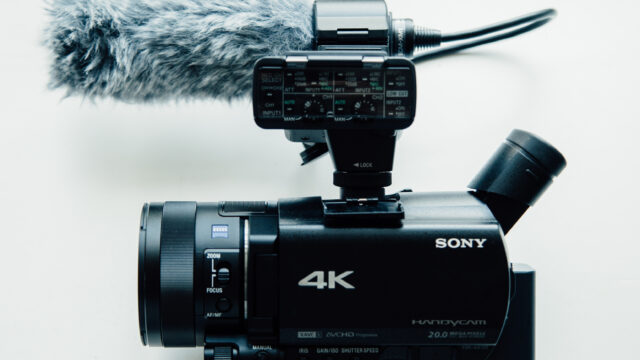


The HM170's $399 XLR adapter, on the other hand, is built into a standard pro camcorder top handle. With the top handle mounted, the HM170 looks like its big brother, the HM200.  In fact, they become identical cameras, with the exception of the HM200's live streaming feature.



The pro HM170 has other standard features the prosumer AX100 lacks - such as HD 4:2:2 color subsampling, dual SD card slots and manual control of color (e.g., color gain, gamma, master pedestal).

At $1795, the HM170 is only a couple of hundred more than the AX100 - but, as of this post, it is the only professional 4K camcorder you can buy right now for less than $2000 (the $1999 Sony PXW-X70 doesn't count because you have to pay another few hundred to upgrade it to 4K).

To be fair, the HM170 is a traditional 1/2.3" sensor camcorder and the AX100 (and the X70) sport the larger 1" sensor.  If you need a 1" sensor, the HM170 is not the camera for you.

That said, if your budget is less than $2000 and you want a 4K camcorder with manual color control, XLR inputs and dual card slots, the $1795 JVC GY-HM170 deal with the free XLR adapter/top handle is pretty much the only game in town.

I have shot with the HM170's large sensor 4K stable-mate, the JVC GY-LS300, and the latest generation of JVC camcorders are the real deal.  Great image quality, good low light performance, pro ergonomics and reasonable prices.  They ought to be selling a whole lot more of them.


Sunday, June 14, 2015

Super 35 camcorder prices continue to fall - 240fps Sony FS700 now $4999!

First generation large sensor camcorder prices continue their steady march downward. First, the Sony FS100 dropped to $2499. Then the Canon C100 dropped to $2999. Recently, the Panasonic AF100's price was slashed to $1999. Now, it's the Sony FS700's turn with a $1000 drop to $4999.

With its 4K sensor, RAW output, 1080/240p frame rate and power zoom compatibility, the FS700 was a breakthrough camcorder in its time. It's still tough to find a camera in this price class with a Super 35mm sensor and 240fps HD slow motion. As a reminder, here's what that looks like:


If you don't need 4K or RAW right now, but want a very capable slo-mo camera with built-in NDs, SDI out, XLRs and great low light performance, this might be a good opportunity to pick up this great Super 35 camcorder.


Tuesday, June 9, 2015

Panasonic AF100 pro camcorder now worth less than a couple of cell phones


Panasonic-launched-Lumix-DMC-CM1-running-Android.1.jpgPanasonic-launched-Lumix-DMC-CM1-running-Android.1.jpg   51CwFnkYpmL._SY355_.jpg         gt11.gif              

  
                                                            \
Interestingly, the same day Panasonic's new $999.99 CM1 "communication camera" rolled out in the States, the company cut the price of its venerable AG-AF100 pro camcorder to $1999.

As a result, the AF100 is now worth less than the price of a couple of cell phones.

Looking back from 2015, it's hard to remember what a pioneering camcorder the AF100 was.  A year after the beginning of the DSLR revolution, Panasonic boldly unveiled a large sensor, interchangeable lens camera with XLR inputs, ND filters, a top handle and camcorder ergonomics and controls.  This was before the FS100, before the C100 and back when Blackmagic Design was still pretty much a video capture card company.

For a while, Panasonic had the market to itself - until its competitors figured out the AF100's vulnerability - its micro 4/3 sensor size.

The competition's first generation pro camcorders were Super 35.  Not only did they perform better in low light - they also had the cachet of a "Hollywood sized sensor."

Very quickly, the AF100 was eclipsed by the Sony FS100, the FS700 and then the Canon Cinema EOS series.

Now, about a half dozen manufacturers (to include AJA, Blackmagic, Kinefinity and JVC) are building sub-$10,000 interchangeable lens Super 35 cameras, while Panasonic's only offering in this price class remains the 5 year old AF100.

Panasonic really needs a Super 35 camera in this price class.  In HCR's opinion, the DVX200, with its micro 4/3 sensor and fixed lens, was a missed opportunity to fill this gap.

In the meantime, for shooters who don't need 10-bit or 4K and don't mind the smaller sensor, this is still a decent 8-bit 1080p camera - and, at $1999, might be worth buying as a starter cam for those want the camcorder form factor and can't afford a $2499 FS100 or a $2999 C100.

As always, if anything here has helped you to make a buying decision, please use the links here to make your purchases - it won't cost you anything extra, and it will help to keep these blog posts coming.  Thank you so much for your support of the revolution!


Friday, March 20, 2015

Pro large sensor, interchangeable lens Sony NEX-EA50 shoulder mount camcorder now costs less than a Handycam!


You can now pick up a sale-priced Sony NEX-EA50UH professional APS-C interchangeable lens camcorder with a shoulder mount, a 18-200mm power zoom lens and XLR mic inputs for $2299 - less than the cost of the NEX-VG30 Handycam with the same lens and a 3.5mm consumer mic input.

These cameras may be limited to 1080p 4:2:0 recording in a 4K 4:2:2 world - but NEX-EA50 shooters such as Henry D.C. Williams nevertheless continue to produce some very good work:


If you're an NEX shooter who wants to upgrade to a professional large sensor camcorder, but who doesn't need 4K, this deal may be for you.

As always, if anything here has helped you to make a purchase decision, please shop using the links above or the displays below and in the margins. And even if you're not in the market for a new camera, please comment and make suggestions below. It won't cost you anything extra, and it will help to keep these posts coming.

And for the latest deals, news, tips and techniques, please follow HCR on Blogger, Twitter and YouTube  - and circle us on Google+.


Wednesday, February 25, 2015

Free Metabones adapter or Rokinon lens with new 4K JVC GY-LS300 at 3/18 LA event!

4K JVC GY-LS300 - $3995 at Adorama - click image to pre-order
In another sign that JVC is going "all out" with the introduction of the GY-LS300, selected dealers are offering a Metabones adapter (EF, Nikon G or PL) or one of two Rokinon full frame Cine DS lenses (24mm or 35mm) for free with the purchase of JVC's new 4K Super 35mm camcorder.

This would be a savings of up to $799 (for the Rokinon 24mm Cine DS lens).

Three dealers offering this promotion are:

If you want to see the camera in person before you order, EVS is hosting the LS300's "LA debut" on March 18th from 1:00 to 3:00PM at their Glendale store.  JVC execs and techs will be there - and there will be a free (with security deposit) "rent before you buy" promotion.

And if you don't need interchangeable lenses, you can get the new 4K JVC GY-HM200 with its fixed 12x zoom lens, and 2/3" sensor for just $2695.

The HM200 is going to put a lot of pressure on the much more expensive 4K camcorders from Sony and Panasonic, the FDR-AX1 and HC-X1000 (as well as JVC's own GY-HMQ10) .

My guess is that the prices of these cameras will have to come down.

As always, if anything here has helped you to make a purchase decision, please shop using the links above or the displays below and in the margins. And even if you're not in the market for a new camera, please comment and make suggestions below. It won't cost you anything extra, and it will help to keep these posts coming.

And for the latest deals, news, tips and techniques, please follow HCR on Blogger, Twitter and YouTube  - and circle us on Google+.


Friday, February 20, 2015

4K JVC GY-LS300 price drops to $3995 - less than 1080p Canon C100!

Pre-order price drop - JVC GY-LS300 now just $3995 (click on the image to pre-order)

I have never seen a 10% pre-order price drop - until now.

JVC rolled out their GY-LS300 Super 35 camcorder in November of 2014 at a list price of $4450.  There has been a lot of buzz about this camera over the last few months (it was Videomaker Magazine's "best of show" camcorder at CES 2015, for example) - but we have seen very little footage (besides this) and no major US reviews.

Quietly, however, the major retail sites have marked the US pre-order price down to $3995 (interestingly, the camera is already in-stock in the UK for £3450.65).

Unless I missed it, the US price reduction has not been announced or even acknowledged by JVC - nor has it been widely promoted by retailers.  Have pre-order numbers been so soft that JVC is cutting prices before the camera ships in the US?  Or is the company simply reacting to Canon's new Cinema EOS prices?

Whatever the reason, what was a good deal for shooters who want to step up to a large sensor, interchangeable lens 4K camcorder - but don't have a big enough budget for the Blackmagic URSA - has suddenly become even better.

$3995 for a Super 35 camera that can record to true 4K makes the LS300 a very attractive choice when compared to a (relatively) low resolution $3999 Canon C100.

With their video-capable DSLRs under pressure from the A7s, NX1 and GH4 - and with the C100 and C300 now under pressure from the LS300 and URSA - it will be interesting to see how Canon responds at NAB 2015 (if they respond at all).

As always, if anything here has helped you to make a purchase decision, please shop using the links above or the displays below and in the margins. And even if you're not in the market for a new camera, please comment and make suggestions below. It won't cost you anything extra, and it will help to keep these posts coming.

And for the latest deals, news, tips and techniques, please follow HCR on Blogger, Twitter and YouTube  - and circle us on Google+.


Saturday, October 25, 2014

Which to buy - the $5499 Canon C100 Mark II or the $5995 Blackmagic URSA EF?


 VERSUS


When Canon introduced the Cinema EOS line back in 2011, they held a big Hollywood event, with expensively produced introductory videos and many of the luminaries of the industry in attendance.  They spent a lot of money and made a big deal of it - and rightfully so.  They were stepping into the big leagues of Super 35mm digital filmmaking with feature-rich and cinematographer-friendly cameras for pro Canon shooters who wanted to step up from DSLRs.

The price points for the new Cinema EOS cameras were high - but not unreasonable in a world where the competition was the then-aging Panasonic AF100 (with its small sensor and poor low light performance) and the newer Sony FS-100 with its strange top mounted LCD/viewfinder and boxy ergonomics.

And when the C100 was introduced a year later, it quickly became a DSLR upgrader's favorite - the only Super 35 camera you could buy below $10,000 with the compact form factor of a DSLR, but with no recording time limit, essentially no moire, built-in XLR jacks with decent pre-amps, a top handle and manual rather than menu-based controls of key camera functions.

And it was 100% compatible with the wide range of Canon EF lenses, which a lot of shooters had in their camera bags.

As a result, over the past couple of years, as the price for this camera dropped from the $6499 introductory price to the current $4499 (for the non-dual pixel autofocus version), Canon sold a lot of them.

But, over the past few years, the landscape has changed. Now we live in a world where $5995 will buy a Blackmagic URSA - an EF mount Super 35 camera with a global shutter and pro SDI out that records to UHD/60p 12-bit RAW.

In this world, it makes a lot less sense to announce a $5499 Canon C100 Mark II that records at a maximum 1080p resolution and 60fps frame rate to an 8-bit compressed codec - and doesn't fix the limitations of the C100's consumer HDMI output.

Nor, as far as I can tell, does it fix the C100's CMOS rolling shutter problem.

Admittedly, URSA is 10 pounds heavier, CFast cards are expensive - and shooting with a "big screen TV" in your face instead of a viewfinder is an acquired taste - but, for TV commercials and indie filmmaking, the URSA's feature set and image quality are competitive with the $20,000 C500 at the price point of a $5499 C100 Mark II with a Blackmagic HDMI to SDI converter.

To quote Filmmaker Magazine, the C100 Mark II "...would be an impressive upgrade — if this were coming out in December 2013."

Even leading C100 advocate and shooter Noam Kroll won't be upgrading.

So, above $10,000, value-conscious filmmakers will probably choose the "C300 killer", the $10,499 4K Sony PXW-FS7 with a 28-135mm f4 servo zoom instead of the $11,999 body-only 1080p C300.

While below $10,000, the $5995 UHD URSA seems to be a much better value for the money than the $5499 C100 Mark II.

If Canon fails to address the resolution/price gap with their competitors, Cinema EOS could very well find itself in the same straits as their DSLR line - where, led by serious shooters like Dave Dugdale and Caleb Pike, Canon shooters seem to be giving up on DSLRs and switching to mirrorless 4K (and 4K capable) Panasonic GH4s and Sony A7s in significant numbers.

As someone whose first video capable interchangeable lens camera was a Canon T2i, I still have hope that the company will step up to the challenge - but even if they don't, there are some great alternatives out there.

As always, if anything here has helped you to make a purchase decision, please shop using the links above or the displays below and in the margins. And even if you're not in the market for a new camera, please comment and make suggestions below. It won't cost you anything extra, and it will help to keep these posts coming.

For the latest deals, news, tips and techniques, please follow HCR on Blogger, Twitter and YouTube and circle us on Google+. Thanks for your support of the revolution!