These cameras both seem to be aimed at the same market, casual shooters who want APS-C DSLR still/video performance in a compact body. Both cameras are equipped with wi-fi, have built-in flash and flip-forward LCDs for self-shooters - and both lack hot shoes and microphone jacks.
But the Sony seems to be the better camera - on features and price.
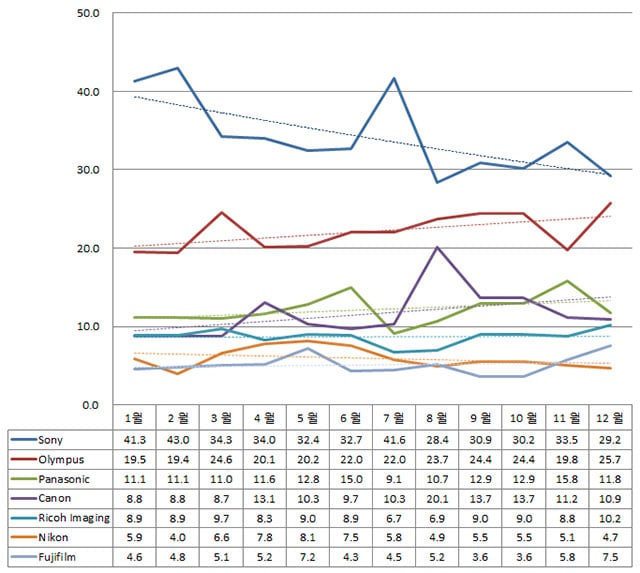
Unfortunately for Canon, they are near the bottom in mirrorless sales in the home market (and worldwide) and have a long way to go if they want to beat Sony and Olympus to get to number one (courtesy BCN via PetaPixel):
Conversely, as DSLR sales fall and mirrorless sales rise (albeit from a lower base) - Sony interchangeable lens camera sales have seen significant growth in the past couple of years, as seen in this chart from the NPD Group:
The new EOS M3 and M10 cameras will certainly be attractive to Canon shooters who want a smaller camera body to complement their APS-C and full frame DSLRs - but appealing to existing users doesn't grow market share. I don't recommend them at this price and don't think Canon will sell enough of them to be competitive (until, like the original EOS M, they are on closeout and selling for bargain basement prices).
If anything here has helped you to make a buying decision, please click on the links above or the display ads below or in the margins. It won't cost you anything extra, and it will help to keep these posts coming.
And please follow HCR here, on G+, on YouTube on Vimeo and on Twitter (button below) for the latest news on micro-budget video and cinema.
A few days ago, when DJI announced they were putting the X3, with its fixed lens and 2/3" sensor, on an integrated "selfie gimbal" (the new DJI Osmo), I have to admit I wasn't impressed.
Fixed lens, small sensor cameras don't fit my style of shooting - even if they record at 4K and are waterproof (e.g., GoPro Hero 4 Black) or are mounted on multicopters (e.g., DJI Phantom 3).
I have admired a lot of the work done with these cameras, especially what Philip Bloom has done with GoPro cameras and DJI copters (below), but it has been difficult to justify the money for a dedicated second camera with a fixed lens that was a lot less flexible and capable than the GH4 I already had.
The combination of the DJI Osmo with the 4K, interchangeable lens X5 and its micro 4/3 sensor changes that (h/t to Andrew Reid at EOSHD for his post on this). If the 1080p YouTube promo video from DJI at the top of this page is any indication, the image quality from the X5 mounted on the Osmo will competitive with high end 4K interchangeable lens cameras mounted on the latest 3-axis gimbals
With a $349.99 gimbal-only Osmo, an integrated $1689 4K X5 and a smartphone, shooters can now produce stabilized 4K, large sensor images like those from a stabilized GH4 (below) for about $60 less than a $1497.99 GH4 combined with a $599 Beholder MS1 (prices as of this post).
No, the Osmo-mounted X5 doesn't have a headphone jack. Nor does it have an EVF or the ability to mount heavy lenses. But, in addition to its price advantage, The Osmo/X5 has the advantage of smaller size and close integration with DJI's multicopter ecosystem.
You can take the X5 off the Osmo and put it on your multicopter with a whole lot less trouble and expense than buying a separate aerial gimbal for a GH4 (or any other DSLR or mirrorless camera).
I haven't touched on the potential presented by the X5R interchangeable lens camera with lossless RAW compression. At $4999 ($7999 mounted on a DJI Inspire 1 Quadcopter), it seems a little overpriced to me (I'd rather have a $4995 URSA Mini 4.6K EF for that much money).
That said, if the price ever comes down, this camera could be very serious competition for the $1295 Blackmagic 4K Micro Studio Camera, which needs a relatively expensive and bulky external recorder for 4K, requires a third party gimbal solution for stable images and is limited to 3840x2160 resolution (compared the X5's 4096x2160).
If anything here has helped you to make a buying decision, please click on the links above or the display ads below or in the margins. It won't cost you anything extra, and it will help to keep these posts coming.
And please follow HCR here, on G+, on YouTube on Vimeo and on Twitter (button below) for the latest news on micro-budget video and cinema.
As far as I can tell, this is the first footage from a consumer who actually bought the camera and doesn't have a special relationship with either Blackmagic Design or a dealer.
This is not a big budget movie with lots of locations - it's something J put together in one day to show his friend (who owns the camera) how to use it. And, clearly, not all of the shots are from the Mini.
That said, the fact that the camera is starting to appear in the hands of consumers is very good news for everyone who has been waiting since April for this camera!
If you've been waiting to place your order until the camera was actually shipping, you can pull the trigger now by clicking on the link above or the display ad below. It won't cost you anything extra, and it will help to keep these posts coming. Thanks for your support of the Revolution!
And please follow HCR here, on G+, on YouTube on Vimeo and on Twitter (button below) for the latest news on micro-budget video and cinema.
Over the past couple of years, as Sony has introduced more and more capable full frame video cameras in still camera bodies - and as Blackmagic Design has driven the price of 12-bit RAW Super 35 cinema cameras downward - shooters have had an increasingly difficult time deciding whether to buy a high end hybrid camera or a RAW-capable budget cinema camera.
Still/video hybrid cameras have had the advantage that they are relatively light and can do double duty as still cameras. And although their highly compressed codecs and 8-bit color spaces aren't the greatest for grading, LOG profiles and increasingly clever compression algorithms have made up for these shortcomings (especially on the small screens where most content is displayed).
One thing they haven't been able to overcome, however, has been the inherent limitations of the still camera form factor. There isn't the volume to fit XLR input jacks or dual card slots - and shooters generally need to spend extra money on cages for these cameras to mount accessories - plus ungainly shoulder rigs for steady handheld shooting.
But low-budget cinema cameras have had their problems too. Early cameras from Blackmagic didn't have XLR inputs. Nor did they have dual card slots or ergonomics that were conducive to shoulder mounting. And, although the 2013-era Blackmagic Production Camera 4K was a bargain compared to a 4K Super 35 camera from Sony or Canon, it was still expensive (and an ergonomic disaster) when compared to a standard mirrorless still/video hybrid camera - which was typically less than $2000 and had interchangeable batteries, a usable viewfinder and was easier to operate than the BMPC 4K..
Both cameras are relatively lightweight, with decent ergonomics and the ability to record high quality UHD to LOG profiles. Both cameras have already shown they can create cinematic Super 35 (URSA Mini) or full frame (A7s) motion images.
With body-only prices at just less than $3000, these cameras seem to be similarly priced. But neither is really ready to take out on a shoot straight out of the box.
This begs the question - once these cameras are rigged up and ready to shoot - are they still price competitive?
To help the typical DSLR or mirrorless shooter looking to upgrade to one of these two cameras, HCR has put together two charts, the first comparing upgrade prices for the typical DSLR upgrader and the second comparing specs.
For the sake of argument, we'll assume that this 'typical' upgrader already has Canon EF lenses and an HDMI EVF (or plans to use the Sony's built-in EVF) - but needs an audio solution and a new cage/shoulder rig compatible with the A7s II. Of course, these assumptions won't be true for everyone, but we have to start somewhere.
Upgrade Price Comparison
For handheld work, URSA Mini needs a battery plate, a battery, the URSA Mini shoulder kit and relatively expensive CFast 2.0 cards, at a minimum, to get started - while the A7s II needs (assuming we want in-camera pro sound and compatibility with EF lenses) an XLR adapter/preamp, a U3 SDXC card, an EF to NEX adapter and a shoulder rig of some kind. Let's run the numbers and see how that prices out:
So, micro-budget filmmakers with EF lenses who don't mind shooting with a $599 800x600 viewfinder (instead of Blackmagic's $1495 1920x1080p viewfinder) can get URSA Mini 4K up and running for about $4395 - while a similar Sony A7s II setup would cost a little more, at around $4460.
These totals are approximate - shaving a few dollars off the A7s II shoulder rig and buying an external recorder rather than a JuicedLink preamp would get the price down for the hybrid camera - but the total cost of getting these cameras ready to shoot is about the same (for this set of assumptions).
One of these side-by-sides wouldn't be complete without a specs comparison:
So how do the specs compare? The URSA Mini, with internal RAW recording and a global shutter, generates high quality images that stand up very well to color grading and camera motion. But (outside of 8MP freeze frames) URSA Mini is not a still camera, needs supplemental lighting in low-light situations and has no in-body stabilization.
The A7s II, on the other hand, is lighter, smaller and the clear winner in low light - but is likely to be more susceptible to "skew" resulting from camera or subject motion - and its 8-bit codec will have a more limited color palette in the grade.
HCR's bottom line for these charts - even though the ready-to-shoot costs are similar, these are two very different cameras with unique strengths and weaknesses. As always, which one you buy or rent depends on your specific needs and preferences and not on comparison charts.
That said, these numbers have broader implications. They show that you can get an ergonomically friendly 4K Blackmagic RAW cinema camera up on your shoulder and ready to shoot - for less than the price of a RED RAVEN brain or a body-only (8-bit) Sony FS5.
This could be a problem for Sony and RED.
If this post has helped you to make a buying decision, please use the links above or the display ads in the margins to make your purchases. It won't cost you anything extra, and it will help keep these posts coming.
And please follow HCR here, on G+, on YouTube on Vimeo and on Twitter (button below) for the latest news on micro-budget video and cinema.
Seven years after the "3K for $3K" Scarlet debacle, RED is delivering 4K for $6K with the EF mount $5950 (brain only) RED RAVEN.
Ready to shoot, with a V-Lock battery mount, touch screen LCD, 120GB RED MAG and handle, RAVEN will be less than $10,000. Not quite #4K4ALL, but a lot closer than we've seen from RED to date.
Nice beauty shots in the intro video:
Sadly, there is no footage from the camera yet, but we have seen enough from RED sensors and color science to be fairly confident in Raven's ability to produce theatrical quality images.
With a brain-only weight of 3.5 lbs, 4K/120p and 2K/240p recorded internally to REDCODE RAW and an advertised 16.5(!) stops of latitude - this is going to be a powerful tool for filmmakers. RED says it's versatile enough for "documentaries, online and television" - but indies will almost certainly choose this camera for feature films on a budget.
But it's still relatively expensive. Ready to shoot, it will cost about the same as a C300 Mark II - but that's not saying much. For shooters upgrading from DSLRs or entry level Super 35 cameras, Raven is going to be a very hard sell - especially when you add the price of a viewfinder, ND filter and rigging.
Here's our usual side-by-side specs comparison with cameras in the same price class (excluding 8-bit cameras such as the Sony FS5, Panasonic DVX200, Canon C100 and JVC LS300):
Again, specs aren't everything - and neither is price - but, in my view, it is useful to know what you're getting for your money.
RED RAVEN is a significant camera. With an advertised March 2016 ship date, we should see it on the show floor alongside URSA Mini at NAB next spring. I can't wait.
Please follow HCR here, on G+, on YouTube on Vimeo and on Twitter (button below) for the latest news on micro-budget video and cinema.
Here are some very nice 4K V-LOG images from Panasonic's first official DVX200 footage (please watch at 2160p and your monitor's highest resolution:
Behind-the-scenes:
And the "First Look" from Zacuto:
I agree with Jens and Steve - at $4195 (pre-order here), this camera is going to be very popular with wedding shooters, documentarians and run and gunners.
That said, the DVX's 8-bit color space and h.264 compression are still a problem. After recording 10-bit 4:2:2 and losslessly compressed RAW to an SD card on a $1000 Pocket Cinema Camera, I don't understand why Panasonic, Canon and Sony still have such a hard time with this in $4000+ cameras.
For me, and other shooters who want less compression and more gradable images, something like the $4995 URSA Mini 4.6K EF is probably a better option - but for shooters who want the convenience of a built-in power zoom lens and don't want or need a lot of flexibility in post, this is going to be a terrific camera.
They shot the first wedding in 10-bit 4:2:2 ProRes HQ at 1080/60p rather than 4K, but I have to say that it looks pretty good - except for the moire on the groom's jacket at 1:10.
The second wedding was shot in 3840x2160 Ultra High Definition, again in ProRes.
This one looks a lot cleaner. If you have a Vimeo Plus or Pro account, you can download it and see for yourself (if you don't, you can sign up for a Pro account here).
The best news, however, is ergonomic. After a couple of generations of Blackmagic cameras that have either looked like toasters or cellphones or weighed too much to carry, the Dreamers say "[The Mini] is incredibly well designed -- everything is exactly where you expect it to be..." (hat tip to nofilmschool.com for the quote).
At $2995 body-only, this camera is a pretty amazing value for the money. For those who can't afford the extra $2000 for the 4.6K version, this is going to be a great, 10-bit entry-level cinema camera.
Blackmagic is clearly going to have to drop the price of the vanilla $2995 Production Camera 4K when URSA Mini 4K starts shipping in volume.




 ), I have to admit I wasn't impressed.
 , an integrated
  and a smartphone, shooters can now produce stabilized 4K, large sensor images like those from a stabilized GH4 (below) for about $60 less than a
  (prices as of this post).


