Blackmagic Pocket Cinema Camera goes to the movies
In the spring of this year, filmmaker Paul Thomas Anderson (There Will be Blood, Boogie Nights) travelled to Rasjathan, India with his friend Jonny Greenwood of Radiohead and producer Nigel Godrich to record an album called Junun (available for pre-order from Amazon and iTunes).
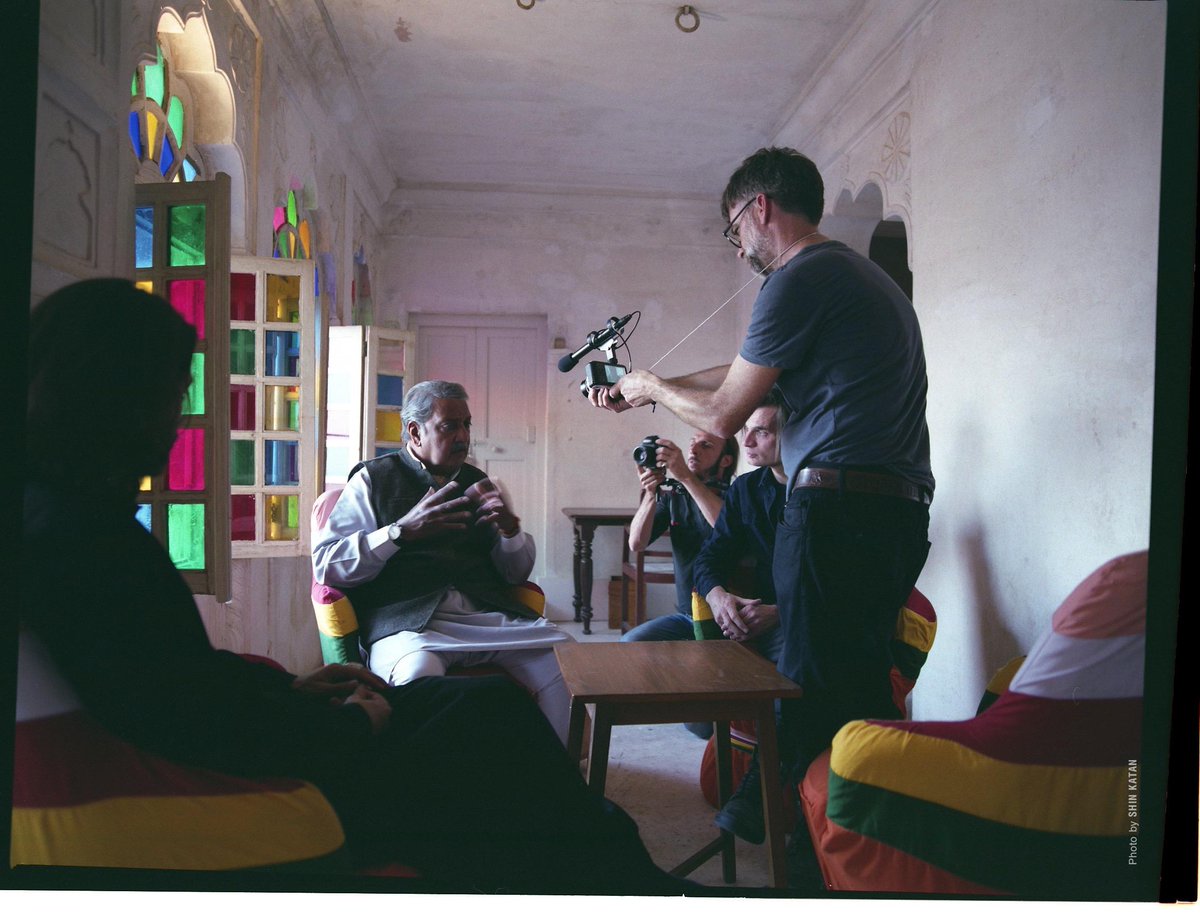
Anderson intended to record the journey and release it as a documentary - but, as he says in this interview at the New York Film Festival, his "newfangled, sexy camera gear" was held up at customs, so he had to resort to Plan B - which turned out to be the Blackmagic Pocket Cinema Cameras he had in his bag (plus Paul Godrich's drone).
Paul Thomas Anderson shooting handheld with the BMPCC (via MUBI on Twitter)
The film, which shares the album's title, was shot verité style in the recording studio and on the streets of Rasjathan and captures the amazing process by which the music was created.
If anything here has helped you to make a buying decision, please click on the links above or the display ads below or in the margins. It won't cost you anything extra, and it will help to keep these posts coming.
And please follow HCR here, on G+, on YouTube on Vimeo and on Twitter (button below) for the latest news on micro-budget video and cinema.
The film was shot in ProRes 4444 with Schneider Cine-Xenar glass and graded in DaVinci Resolve. Diez says the camera's global shutter was important for capturing the flashes, explosions and sudden camera movements that were a key part of the film.
I'm not a big fan of this genre, but it's good to see URSA and other under $10,000 cameras being used as A cams on indie sets. Money not spent on renting $40,000 cameras can go into salaries for "name" actors and real practical effects (instead of CGI).
Big Dolph Lundgren on the big URSA monitor (from Flickr)
The great thing about the era we live in is you can click on the graphic below on the right and stream the movie in the comfort of your home or office - or even on mobile - and, if you like the way it looks, you can click on the graphic on the left and buy the camera it was shot on. I love this century.
If anything here has helped you to make a buying decision, please click on the links above or the display ads below or in the margins. It won't cost you anything extra, and it will help to keep these posts coming.
And please follow HCR here, on G+, on YouTube on Vimeo and on Twitter (button below) for the latest news on micro-budget video and cinema.
A few days ago, when DJI announced they were putting the X3, with its fixed lens and 2/3" sensor, on an integrated "selfie gimbal" (the new DJI Osmo), I have to admit I wasn't impressed.
Fixed lens, small sensor cameras don't fit my style of shooting - even if they record at 4K and are waterproof (e.g., GoPro Hero 4 Black) or are mounted on multicopters (e.g., DJI Phantom 3).
I have admired a lot of the work done with these cameras, especially what Philip Bloom has done with GoPro cameras and DJI copters (below), but it has been difficult to justify the money for a dedicated second camera with a fixed lens that was a lot less flexible and capable than the GH4 I already had.
The combination of the DJI Osmo with the 4K, interchangeable lens X5 and its micro 4/3 sensor changes that (h/t to Andrew Reid at EOSHD for his post on this). If the 1080p YouTube promo video from DJI at the top of this page is any indication, the image quality from the X5 mounted on the Osmo will competitive with high end 4K interchangeable lens cameras mounted on the latest 3-axis gimbals
With a $349.99 gimbal-only Osmo, an integrated $1689 4K X5 and a smartphone, shooters can now produce stabilized 4K, large sensor images like those from a stabilized GH4 (below) for about $60 less than a $1497.99 GH4 combined with a $599 Beholder MS1 (prices as of this post).
No, the Osmo-mounted X5 doesn't have a headphone jack. Nor does it have an EVF or the ability to mount heavy lenses. But, in addition to its price advantage, The Osmo/X5 has the advantage of smaller size and close integration with DJI's multicopter ecosystem.
You can take the X5 off the Osmo and put it on your multicopter with a whole lot less trouble and expense than buying a separate aerial gimbal for a GH4 (or any other DSLR or mirrorless camera).
I haven't touched on the potential presented by the X5R interchangeable lens camera with lossless RAW compression. At $4999 ($7999 mounted on a DJI Inspire 1 Quadcopter), it seems a little overpriced to me (I'd rather have a $4995 URSA Mini 4.6K EF for that much money).
That said, if the price ever comes down, this camera could be very serious competition for the $1295 Blackmagic 4K Micro Studio Camera, which needs a relatively expensive and bulky external recorder for 4K, requires a third party gimbal solution for stable images and is limited to 3840x2160 resolution (compared the X5's 4096x2160).
If anything here has helped you to make a buying decision, please click on the links above or the display ads below or in the margins. It won't cost you anything extra, and it will help to keep these posts coming.
And please follow HCR here, on G+, on YouTube on Vimeo and on Twitter (button below) for the latest news on micro-budget video and cinema.




 ), I have to admit I wasn't impressed.
 , an integrated
  and a smartphone, shooters can now produce stabilized 4K, large sensor images like those from a stabilized GH4 (below) for about $60 less than a
  (prices as of this post).